
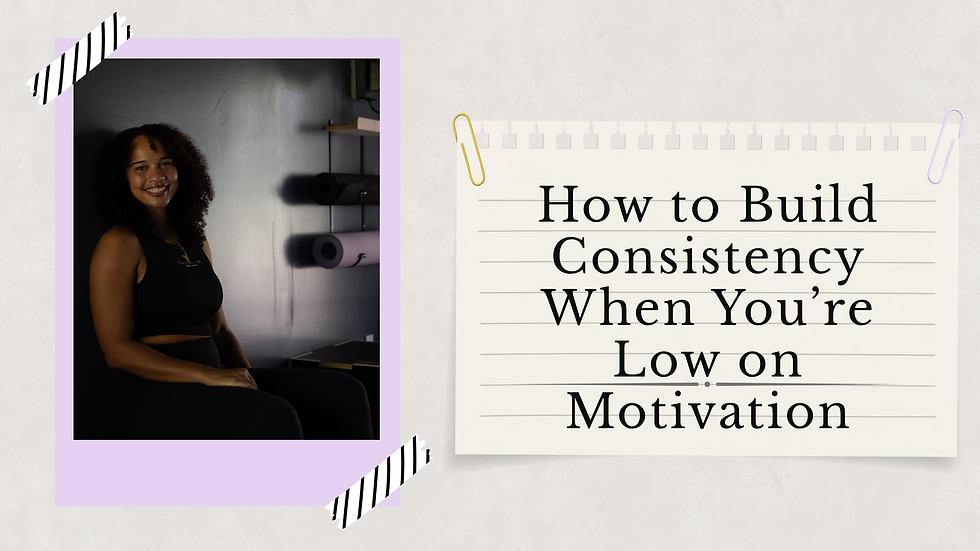
How to Build Consistency When You’re Low on Motivation

Updated: Aug 31
ou know what you're supposed to do.
You planned the workout.
You bought the groceries.
You set the goal.
You genuinely want the result.
You just don't feel like doing any of it today.
This is where most people assume they have a motivation problem.
But you don't need to feel motivated every time you take care of yourself.
In fact, consistency becomes much easier when you stop requiring motivation in the first place.
Motivation changes with your energy, mood, stress, schedule, sleep, and about a hundred other things you can't completely control.
So instead of trying to figure out how to stay motivated all the time, build a routine that still gives you something to do when motivation is nowhere to be found.
Here's how.
1. Lower the Bar Instead of Quitting
One of the most useful things you can learn is how to make a habit smaller without deciding it no longer counts.
Your original plan was a 45-minute workout.
You have 20 minutes.
Do 20.
You planned to cook dinner but you're exhausted.
Make the easiest balanced meal you can.
You wanted to walk three miles.
Walk around the block.
This isn't an excuse to permanently avoid challenging yourself.
It's a strategy for staying connected to the habit when your capacity is lower than expected.
Think of it as your minimum version.
Ask yourself:
What's the smallest version of this that would still feel worthwhile today?
Then do that.
The goal on a low-motivation day isn't necessarily to have your best day.
Sometimes it's simply to keep the rhythm going.
2. Remove as Many Decisions as Possible
Low motivation becomes much harder to overcome when completing the habit requires twelve decisions first.
When am I going to work out?
What workout should I do?
Where are my clothes?
Do I have enough time?
Should I go now or later?
By the time you've negotiated with yourself for 20 minutes, skipping it sounds fantastic.
Instead, make some of those decisions ahead of time.
Schedule your workouts before the week starts.
Know which workout you're doing before you get to the gym.
Keep a few easy meals in regular rotation.
Put your walking shoes somewhere accessible.
Pack what you need the night before.
Create a backup plan for busy days.
The fewer steps between you and starting, the less motivation you need to get there.
That's one of the reasons the boring habits that actually change your body are so effective. They're repeatable enough that eventually you don't have to reinvent your routine every day.
3. Create a Plan B Before You Need It
Most people create routines for their best days.
Then they're surprised when those routines fall apart during their busiest ones.
Build two versions instead.
Plan A is what you do when life goes reasonably according to plan.
Plan B is what you do when it doesn't.
For example:
Plan A might be a full strength workout at the gym.
Plan B might be a 20-minute home workout.
Plan A might be cooking the dinner you planned.
Plan B might be assembling an easy meal from things you intentionally keep available.
Plan A might be your normal morning routine.
Plan B might be doing the two pieces that matter most before you leave the house.
Now a disrupted day doesn't require you to decide between doing everything and doing nothing.
You already know what the alternative is.
Flexibility is part of consistency—not the opposite of it.
4. Shrink the Habit Until Starting Feels Easy
Sometimes the hardest part isn't completing the habit.
It's starting it.
So make your first step almost ridiculously easy.
Don't tell yourself you have to complete an entire workout.
Tell yourself to put your shoes on.
Don't tell yourself you need to clean the entire kitchen.
Put five things away.
Don't tell yourself you have to journal for 20 minutes.
Write one sentence.
Don't tell yourself you have to walk three miles.
Walk for five minutes.
Once you've started, you may decide to continue.
Great.
But you don't have to.
The point is to practice starting without requiring a huge burst of motivation first.
This is especially useful when you're building healthy habits that actually stick, because making a behavior easier to repeat gives you more opportunities to practice it.
5. Make Your Environment Do Some of the Work
Your surroundings can either create friction or remove it.
If the behavior you want requires digging equipment out of a closet, finding your shoes, clearing a space, choosing a workout, and locating your headphones, you've created five opportunities to decide never mind.
Instead, look for ways to make your desired behaviors easier.
Keep water nearby.
Put your workout clothes somewhere easy to grab.
Have convenient protein options available.
Keep commonly used equipment accessible.
Put your medications or supplements somewhere appropriate that you'll see them when you're supposed to take them.
Keep healthy foods you actually enjoy in the house.
Set up your environment for the person you want to be before that person is tired and cranky at the end of a long day.
You don't need perfect willpower if you've already made the supportive choice easier.
6. Stop Waiting to “Feel Like Yourself Again”
Low-motivation seasons can create an interesting trap.
You keep waiting until you feel energetic, disciplined, organized, and motivated enough to return to your routine.
But sometimes action has to come first.
You don't need to suddenly feel like your best self before taking one supportive step.
At the same time, there's an important distinction between low motivation and genuine depletion.
If you're simply not excited about your workout, starting with the minimum version may be exactly what you need.
If you're consistently exhausted, sleeping poorly, struggling to recover, or feeling overwhelmed by everything—not just exercise—pushing harder may not be the answer.
That's when supporting your body instead of fighting it becomes more important than forcing another habit onto your schedule.
Consistency includes learning when to push and when to adjust.
7. Focus on the Person You're Practicing Becoming
Goals matter.
But outcomes can take a long time.
If your only reward for exercising is reaching a goal months from now, it's easy to feel like today's workout didn't accomplish much.
Instead, notice what today's action says about you.
I'm someone who takes care of myself.
I'm someone who can adjust without quitting.
I'm someone who moves my body regularly.
I'm someone who comes back after a hard week.
You don't need to repeat those phrases until you magically believe them.
Build the evidence.
Every time you follow through—even imperfectly—you give yourself another reason to believe that description is true.
That's how consistency can begin to build confidence.
8. Track Follow-Through, Not Just Outcomes
The scale isn't going to reward you every morning.
Your muscles won't visibly change after every workout.
Your energy won't necessarily improve after one early bedtime.
But you can still measure whether you're practicing the behaviors that move you forward.
Track things like:
Workouts completed
Walks taken
Strength improvements
Meals that supported your goals
Bedtimes
Water intake
Habits completed
Times you used Plan B instead of quitting
Those wins give you evidence that something is happening even when the eventual outcome is still developing.
If you're strength training, my FREE Strength & Confidence Tracker can help you notice progress beyond the scale—including the consistency and confidence you're building along the way.
9. Don't Let One Miss Become a Pattern
You will miss things.
That's part of having a life.
The important part is what happens next.
You miss Tuesday's workout.
Fine.
When can you move next?
You order takeout instead of cooking.
Okay.
What sounds supportive for your next meal?
You stay up too late.
It happens.
What time are you going to bed tonight?
You don't need to compensate.
You don't need to punish yourself.
And you definitely don't need to wait until Monday.
If you've been completely out of your routine for a while, resetting your wellness routine without overwhelm can help you find a realistic way back.
Otherwise?
Just take the next opportunity.
10. Remember That Motivation Was Never the Goal
Motivation is useful.
Enjoy it when it's there.
Use that burst of energy to get started, make plans, prepare your environment, or try something new.
But don't build a routine that requires you to stay excited forever.
Motivation gets you started. Systems give you somewhere to go when the excitement wears off.
That's the bigger reason consistency beats motivation every time.
You aren't trying to become someone who wakes up thrilled to do every healthy habit for the rest of her life.
You're building a routine that makes taking care of yourself normal enough that you can continue even when you aren't particularly excited about it.
The Bottom Line
When motivation is low, don't immediately assume you need a better pep talk.
Make the habit smaller.
Remove decisions.
Create a Plan B.
Reduce friction.
Track your follow-through.
Know the difference between I don't feel like it and I genuinely need recovery.
And when you miss something, take the next opportunity instead of creating another dramatic restart.
You don't need to be motivated every day.
You need a way to keep going on the days you aren't.
If creating that structure on your own is the part you struggle with, that's exactly what we work on inside The Wellness Method.
Your workouts, habits, and strategies are built around your actual schedule and capacity—with coaching and accountability to help you adjust when real life inevitably changes the plan.


Comments